Your customers are about to stop clicking your link and start asking an AI whether you’re worth recommending. Google’s I/O 2026 Search update is what makes that real. Here’s what actually changed, and how to be the brand the AI reaches for instead of the one it skips.
At I/O on May 19, Google called its update “a new era for AI Search.” That’s a big claim, but the changes back it up: they shift where people find answers, who or what does the searching, and what a brand has to do to show up in the results.
We’ve spent the last year watching clients react to AI Overviews and AI Mode by asking the wrong question: “How do we beat AI?” You don’t. The better question, and the one this update forces, is “How do we become the thing the AI reaches for?” Loop’s take hasn’t changed since AI Mode launched: AI discoverability is just SEO done for a new interface. The I/O announcements make that clearer than ever.
Below is what actually shipped, what’s still a promise, and the part Google’s blog won’t tell you what each of these changes does to your visibility, broken down by the kind of brand you’re running.
What google actually announced
Source: Engadget
Four things, in order of how much they’ll reshape your visibility strategy.
1. A smarter default brain.
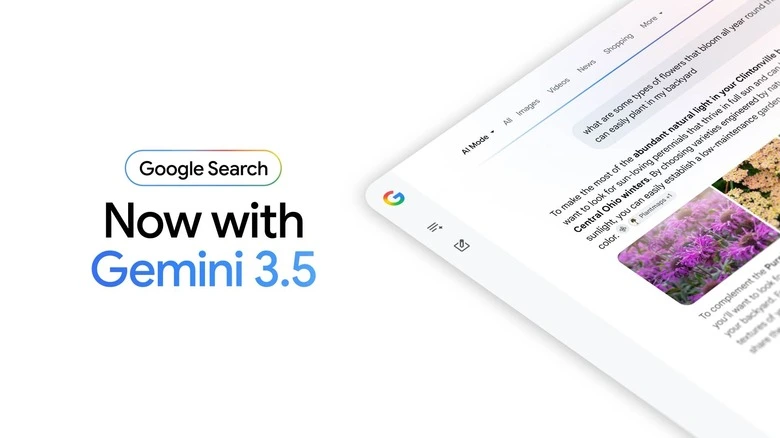
Gemini 3.5 Flash is now the default model powering AI Mode, rolled out globally starting at I/O. Google describes it as built for “agents and coding,” which matters less for the model name and more for what it enables the three things below.
2. A reimagined Search box.
Source: Google
Google calls this the biggest upgrade to the Search box in over 25 years. It expands as you type, suggests how to phrase your question (beyond old-style autocomplete), and the part brands should circle accepts multimodal inputs: text, images, files, video, and even open Chrome tabs. This is live now, in every country and language where AI Mode is available.
3. Search agents.
Source: Google
This is the biggest leap. Google is introducing Search agents starting with information agents that run in the background 24/7, monitoring the open web (blogs, news, social) plus Google’s real-time data (finance, shopping, sports) for changes tied to a question you’ve set. Apartment hunting, a sneaker drop, a price change the agent watches and pings you. Alongside it, Google is expanding agentic booking to local experiences and services, and for select categories (home repair, beauty, pet care) it can call businesses on your behalf. Information agents launch first for Google AI Pro & Ultra subscribers this summer; the booking and calling expansion rolls out to everyone in the U.S. this summer. (Source: Google)
4. Agentic coding and Personal Intelligence.
Source: Google
Search can now generate custom interfaces on the fly tables, interactive visuals, simulations, even returnable “mini apps” like a fitness tracker powered by Google Antigravity.
Generative UI is slated for everyone, free, this summer; the persistent mini-apps start with AI Pro & Ultra subscribers in the U.S. in the coming months. Separately, Personal Intelligence in AI Mode is expanding to nearly 200 countries and 98 languages, letting users connect Gmail and Google Photos (Calendar soon), no subscription required. (Source: Google)
And the headline stat Google led with: AI Mode passed one billion monthly users about a year after launch, with queries reportedly more than doubling every quarter.
That’s the announcement. Now the part that’s actually your job.
Why this changes discoverability, not just search
Strip away the product names and three structural shifts emerge and each one rewrites a rule you’ve been optimizing against.
The answer is increasingly the destination. AI Mode and AI Overviews synthesize before they link. A user can now ask a follow-up directly inside an Overview and slide into a full AI Mode conversation, context intact. The implication is blunt: ranking #1 for a keyword is worth less than being one of the sources the synthesis is built from. Position has been partly replaced by inclusion.
Discovery is becoming continuous, not a moment. Information agents mean a chunk of “search” stops being a person typing a query and becomes a machine re-checking the web around the clock. You’re no longer optimizing for the instant someone searches “best roofing contractor.” You’re optimizing to be the source an agent surfaces whenever its conditions are met a price drop, a new listing, a fresh review. Freshness and structured, machine-readable signals stop being nice-to-haves.
Inputs are multimodal, so your assets are now query targets. When someone can search by pointing their camera, uploading a file, or feeding in a Chrome tab, your product photography, spec sheets, and diagrams become things Google reads to match intent, not just decoration around your text. Your images are now part of your index.
This is what we mean by GEO generative engine optimization. It’s not a replacement discipline that retires SEO. It’s SEO’s center of gravity moving from “rank the page” to “be the citable, machine-legible, trustworthy source the model pulls into its answer.” The fundamentals Google has preached for years original information, demonstrated first-hand experience, clear authorship, trustworthiness didn’t get less important. They became the entry ticket to being cited at all.
What it takes to get cited in an AI answer now
There’s no published “ranking factor” for AI Overview citations, and anyone selling you one is guessing. But the pattern across what gets pulled is consistent, and it lines up almost exactly with Google’s own helpful-content guidance:
- Answer the specific question cleanly and early. Models extract. A page that states a clear, self-contained answer near the top then supports it is easier to cite than one that buries the payoff under 600 words of preamble.
- Show first-hand experience the model can’t synthesize from ten other pages. Original testing, real numbers, your own photos, a named practitioner’s take. If your content is a paraphrase of the same ten sources the AI already read, there’s no reason to cite you specifically.
- Make authorship and trust unmissable. A real byline, a real bio, a real About page, accurate sourcing. Google has said for years that of E-E-A-T, trust is the one that matters most. That hasn’t moved. (Source: Google Search Central)
- Be structurally legible. Clean headings, descriptive subheads, structured data, tables where tables belong. The easier you are to parse, the easier you are to lift.
- Be fresh in a way that’s real. Genuinely updated information, not a changed date on a stale page. Agents reward actual change; Google explicitly warns against faking it.
What to do next broken down by who you are
The agentic features hit different business types very differently. Find yourself below.
If you’re a content or SEO team
Your unit of optimization is shifting from “the page” to “the passage.” Restructure content so each section answers one question completely and could stand alone if lifted. Audit your highest-traffic pages for whether they demonstrate genuine first-hand expertise or just summarize the summarizers are the first to get disintermediated by synthesis. Add and surface real author identity everywhere it’s plausibly expected. And start tracking a new metric alongside rankings: citation share how often you appear as a cited source in AI Mode and AI Overviews for your priority topics. Most rank trackers are racing to add this; build the habit of checking manually now.
If you’re an e-commerce brand
With multimodal search, your images aren’t just decoration, they’re part of what you rank for. Clean, accurately tagged product photos, spec data, and structured product markup are now how visual and file-based queries find you. Get your structured data and feed hygiene airtight, because agentic shopping and booking lean on machine-readable availability and pricing. And watch the agentic-commerce rollout closely Google flagged new shopping capabilities in a companion announcement because when an agent is comparing options on a user’s behalf, the brand with clean, current, structured data is the one that gets surfaced.
If you’re a local or service business
This is the one to act on. Agentic booking and Google calling businesses on a user’s behalf roll out to everyone in the U.S. this summer, with home repair, beauty, and pet care named as launch categories. If you’re in one of those, your Google Business Profile, real-time availability, accurate hours, and critically how your staff handles an inbound AI-placed call are about to become part of your conversion funnel. A brand that can’t be booked or reached programmatically becomes invisible to an agent doing the legwork. Test what happens today when someone tries to book or call you through Google. If you’re outside the U.S., this isn’t live for your customers yet but the U.S. rollout is your preview, so prepare now rather than scramble later.
A practical checklist
Pin this to the wall:
- Audit your top 20 pages for clear, self-contained answers near the top and fix the ones that bury their main point too far down.
- Add real bylines and bios to anything resembling expertise content. Trust is the priority signal.
- Fix your structured data products, articles, local business, FAQ. This is how machines read you.
- Clean and tag your image and product assets. They’re query targets now.
- Claim and complete your Google Business Profile, especially if you’re in home repair, beauty, or pet care.
- Stress-test your booking and phone flow as if an AI agent were the customer.
- Start measuring citation share, not just rankings.
- Update content because it changed, never to fake freshness Google penalizes the latter.
Common mistakes brands are about to make
“Google killed SEO, so we’re stopping.” No. The mechanics shifted; the discipline didn’t die. Pulling investment now cedes citation share to competitors at the exact moment it’s being received.
Chasing the features that aren’t live yet. Information agents and persistent mini-apps are summer-and-beyond, subscriber-tiered, and partly U.S.-only. Don’t rebuild your strategy around a capability your customers can’t use this quarter. Build for what’s live the multimodal box, AI Mode synthesis, Personal Intelligence and stage the rest.
Treating GEO as a separate budget line. It isn’t a new vendor or a bolt-on tool. It’s the same content, technical, and trust work you should already be doing, pointed at a new surface.
Faking freshness. Re-dating stale pages to look current is explicitly called out by Google as a search-engine-first warning sign. Agents that monitor for real change will be even less forgiving of cosmetic updates.
Ignoring the phone. If agentic calling reaches your category and a real person fumbles the AI-initiated call, you’ve optimized everything upstream just to lose at the finish line.
FAQ
Is AI Mode replacing regular search results?
No. Google was explicit that you still get a range of results just like today; AI Mode and AI Overviews sit alongside them, with an easier path to flow from an Overview into a conversation.
Do I need to do anything technically different to “rank” in AI Mode?
There’s no separate AI Mode ranking system Google has disclosed. The signals that earn citations map closely to long-standing helpful-content and E-E-A-T guidance. Be original, experienced, trustworthy, and structurally clean.
When can my customers actually use Search agents?
Information agents launch first for AI Pro & Ultra subscribers this summer. Agentic booking and calling roll out to everyone in the U.S. this summer. Outside the U.S., expect to wait. Re-verify dates against Google’s source as rollouts often shift.
Is Personal Intelligence a privacy problem for my brand?
Its user-controlled people opt in to connect Gmail, Photos, and soon Calendar. For brands it mostly means answers can be more personalized to a user’s context, which raises the bar on relevance rather than creating a direct action item.
Should I be worried about losing clicks to AI answers?
Be realistic, not panicked. Some informational clicks will be absorbed by synthesis. The counter-move is to be the cited source (which still drives qualified traffic and brand authority) and to own the queries with real commercial or experiential intent that AI summaries can’t fully satisfy.
The Loop take
The brands that win the next 12 months won’t be the ones that “did GEO.” They’ll be the ones that were already producing genuinely useful, experience-backed, well-structured content with a real human name on it because that’s now the same thing as being machine-discoverable.
If you want a clear-eyed audit of where your content stands against this shift, what’s citable, what’s invisible, and what to fix first that’s the work we do.
Comments are closed