Last Updated June 2026 · 11 min read
Paid placements now live inside Google’s AI-generated answers. Here’s what the ad formats look like in 2026 and what the shift means for your brand’s visibility.
A shopper asks Google how to make a small bathroom feel like a spa. Before they finish reading the AI-generated summary at the top of the page, a sponsored product recommendation is already woven into it: a short explainer, an image, a “Sponsored” tag. That is the shape of Google AI Overviews ads in 2026: paid content living inside the answer, not beside it. At Google Marketing Live 2026 on May 20, 2026, Google confirmed a new generation of Gemini-built ad formats designed to read like part of the answer, the most recent step in a shift that began when ads first came to AI Overviews on desktop and AI Mode in May 2025. For brand teams, this is more than a new ad unit. It changes where visibility lives, how budgets flex, and how much trust users place in what they read. Here’s what these ads actually look like, how they behave, and what the shift means for your brand.
Key Takeaways
- Ads now appear inside AI Overviews (the AI summaries atop results) and AI Mode (Google’s conversational search), on desktop and mobile, expanding across markets through 2026.
- Formats range from familiar Search and Shopping ads to newer Gemini-built units Conversational Discovery ads, Highlighted Answers, and AI-powered Shopping ads all tagged “Sponsored.”
- The biggest implication: organic real estate is compressing, so paid presence inside the answer is becoming a visibility requirement, not an option.
- Transparency is unsettled ads blend into AI answers, and dedicated performance reporting for these placements is still thin.
What’s Happening
Ads first appeared inside AI Overviews on desktop in May 2025, when Google confirmed at Google Marketing Live 2025 that it was expanding ads to AI Overviews on desktop and bringing them to AI Mode. Since then, Google has moved quickly. Paid placements now serve inside both AI Overviews, the AI-written summaries at the top of many results, and AI Mode, Google’s fuller conversational search experience, across desktop and mobile.
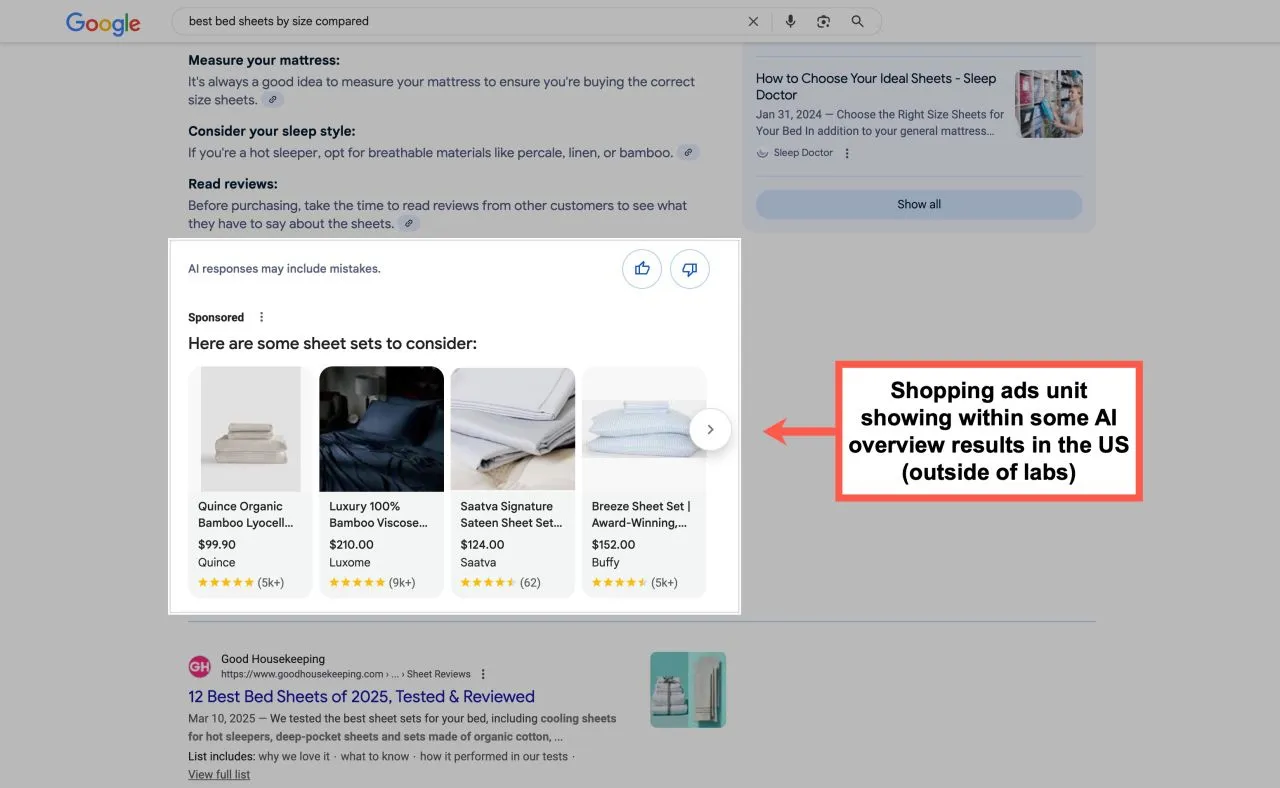
Source: Linkedin
By 2026 the rollout has widened well beyond the US, with AI Overviews expanding across markets and languages. Scale is the real story: independent analyses suggest ads now surface in roughly a quarter of AI results, up sharply year over year, though Google hasn’t published a definitive figure. AI Mode itself has grown into the hundreds of millions of users. For brands, this is no longer an experiment at the edge of search, it’s becoming the main event.
What the Ads Actually Look Like
At Google Marketing Live 2026, Google introduced a new generation of Gemini-powered ad formats built for AI answers. Rather than sitting in a separate block, they’re written to read like part of the response. Alongside the familiar text and Shopping ads, the newer units generate creative in real time to match the query and the surrounding summary. One clarification worth making: “Gemini-powered” here means Gemini builds the ad creative inside Google Search surfaces; it does not mean ads are running inside the standalone Gemini app. In December 2025, Google’s VP of Global Ads said there were no ads in the Gemini app and no plans to add them; by its Q1 2026 earnings call, leadership had softened to being open to exploring the idea if the Search formats prove useful. For now, the Gemini assistant remains ad-free, and everything in this piece refers to ads in AI Overviews and AI Mode.
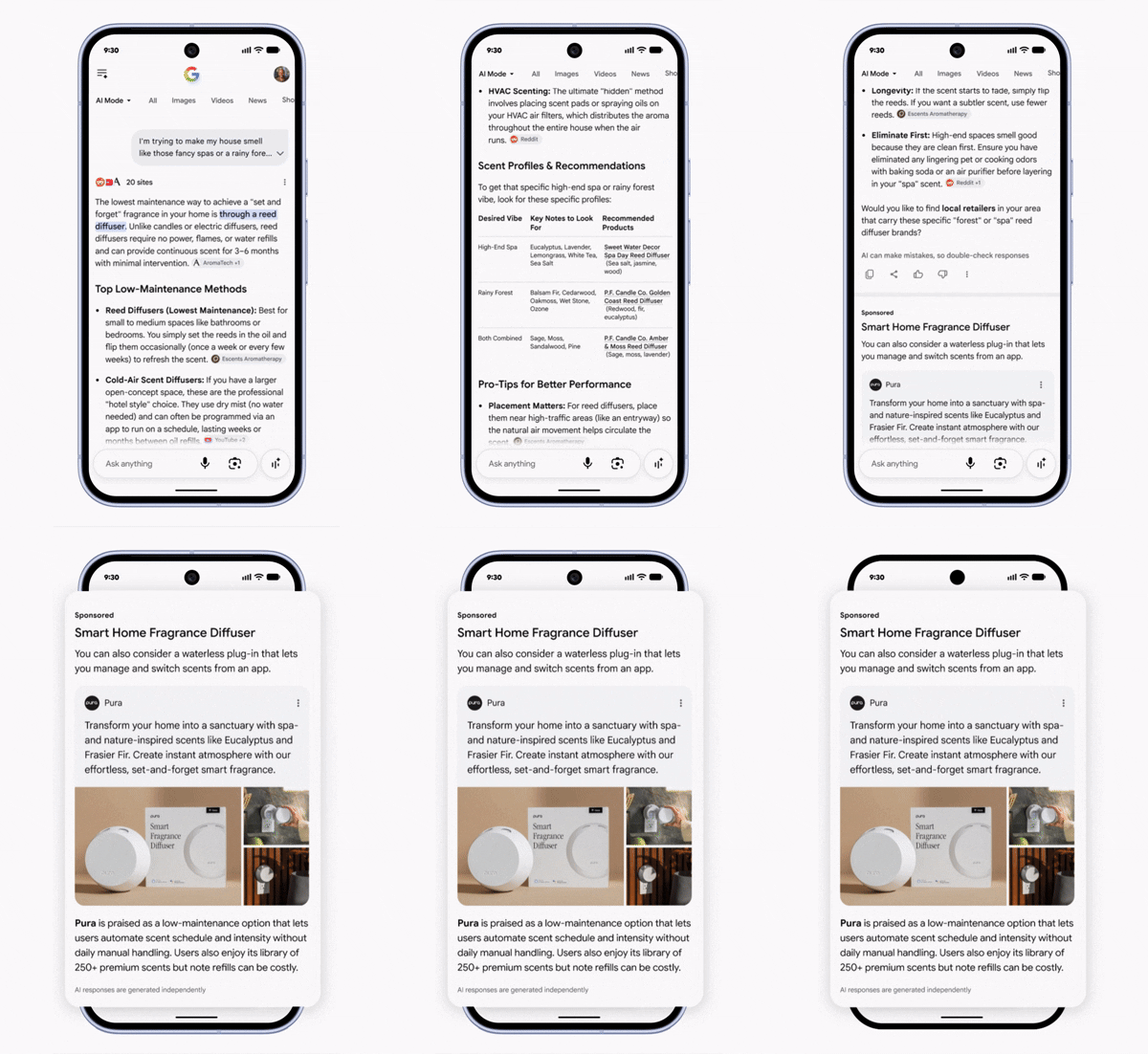
Source: Google
|
Format |
What it looks like |
Where it appears |
|
Search & Shopping ads (existing) |
Familiar text ads and product listings with images, placed above or inside the summary |
AI Overviews, desktop and mobile |
|
Conversational Discovery ads |
A Gemini-written response to the user’s specific question, paired with advertiser creative and a separate AI explainer |
AI Mode (US testing) |
|
Highlighted Answers |
Advertiser content surfaced as a direct answer, alongside a neutral AI-generated explainer |
AI Mode (US testing) |
|
AI-powered Shopping ads |
Product picks with a custom, query-specific explanation of why the item fits |
AI Overviews / AI Mode |
All of these placements carry a “Sponsored” label. Direct Offers a pilot Google launched in January 2026 with brands such as Chewy, Gap, and L’Oréal extends the same idea to deals and native checkout. Much of this is still evolving: several formats remain in limited US testing, and how they render will keep shifting as Google iterates.
Why It Matters for Brands
Organic space is shrinking. When an AI summary answers the question and an ad sits inside it, the traditional links get pushed down and in AI Mode, most sessions end without a click to any external site at all. That compression makes paid presence inside the answer less of a nice-to-have. Staying visible now means planning for both organic and paid, together the through-line in how brands stay visible as search turns into answers.
Budgets and bidding are shifting toward the answer. Because these placements draw on Performance Max and AI Max campaigns rather than a separate buy, spend flows into AI surfaces whether you plan for it or not. Early third-party data points to higher engagement at a higher cost per click, and auction pressure is concentrating on commercial, lower-funnel moments, a dynamic worth tracking against broader performance marketing trends.
The ads are always labeled “Sponsored.” The problem is that the label is easy to miss: when an ad is written in the same voice as the AI answer and sits inside it, readers can skim past it without registering it as paid. That helps brands reach people but puts trust at risk. The brands that treat these placements as a trust moment keeping them accurate, clear, and useful will hold up better over time.
Feed and creative readiness decides who shows up. Gemini builds much of this creativity from your product feed and page content on the fly, so thin descriptions, missing images, or stale prices quietly cut your odds of appearing. Structured, complete data is now a visibility lever, the practical core of how brands appear in AI answers.
The Transparency Question
Embedding ads in AI answers brands’ premium real estate, but it blurs the paid/organic line at the exact moment users are trusting the machine to be neutral. Google labels these placements “Sponsored,” and in mid-2026 added a How this ad was made disclosure for AI-created creative. Reporting is still the weak spot: ads inside AI Overviews largely roll up as standard “top ads” in Google Ads, with no clean breakout for AI-answer placements. For now, measuring what these ads actually do for your brand remains an open question.
What Brand Teams Should Do Now
- Audit your AI-search visibility. Check which priority queries now trigger AI Overviews or AI Mode, and where your brand shows up paid or organic.
- Get feeds and structured data in shape. Complete, accurate product data and clear page content are what Gemini draws on to build these ads.
- Revisit creative for a summary-first context. Copy that reads like a helpful answer will outperform interruptive promotion inside AI responses.
- Watch reporting as it matures. Track engagement and cost shifts in Performance Max and AI Max, and push for placement-level clarity as Google adds it.
- Keep messaging clear and trustworthy. When your ad sits inside an “answer,” accuracy protects the brand more than clever positioning.
How Loop Agency Thinks About AI Search
We treat paid and organic presence as one connected brand experience, not two separate budgets. As search shifts toward AI answers, staying visible and staying trusted become the same job: showing up in the moment someone is deciding, in a way that reflects your brand honestly. It’s the same lens behind our view on adapting to AI. If your team is working out where your brand fits in AI-era search, we’re happy to talk it through.
FAQ
What are ads in Google AI Overviews?
They’re paid placements that appear inside Google’s AI-generated summaries at the top of search results. Instead of sitting in a separate block, they blend into the answer as text ads, product listings, or Gemini-written recommendations each marked “Sponsored” drawing on your existing Search, Shopping, and AI Max campaigns.
Where do ads appear in AI Overviews and AI Mode?
In AI Overviews, ads can appear within the AI-generated summary itself, each marked “Sponsored.” In AI Mode, they surface below and woven directly into the conversational reply. Both run on desktop and mobile. As of 2026 they’re expanding across more markets and languages, with several newer AI Mode formats still in limited US testing.
What ad formats show up in AI Overviews?
You’ll see familiar Search text ads and Shopping product listings, plus newer Gemini-built formats: Conversational Discovery ads, Highlighted Answers, and AI-powered Shopping ads that write a custom explanation of why a product fits the query. All are labeled “Sponsored.”
Are AI Overview ads labeled as ads?
Yes. Google marks these placements with a “Sponsored” label, and in mid-2026 added “How this ad was made” disclosures for AI-created creative. Still, because the ads are written in the same style as the AI answer, some users may not immediately recognize them as paid.
Can advertisers see performance data for AI Overview ads?
Only partially. Ads in AI Overviews currently roll up into standard “top ads” reporting in Google Ads, without a dedicated breakout for AI-answer placements. Google is improving campaign transparency in 2026, but clean, placement-level measurement for these ads remains limited.
You Might Also Like
- Google’s 2026 AI Search Update: How Brands Stay Visible
- AEO and GEO Explained: How People Find Brands in AI Answers
- Performance Marketing Trends to Watch in 2026
- How Marketing Agencies Are Adapting to AI
Work With Loop Agency
Search is becoming a place where the answer and the ad share the same space. Loop Agency helps brands stay visible and trusted through that shift connecting strategy, content, and paid presence so your brand shows up clearly wherever people are searching. If that’s on your roadmap, let’s talk.