Claude’s text watermarking has become one of the more talked-about AI developments of the moment.
The idea certainly sounds significant. Text generated by supported Claude models can contain an invisible, machine-readable watermark designed to indicate that Claude may have processed the content.
But the amount of attention around the announcement is interesting for another reason:
Text watermarking by major AI companies is not new.
Google DeepMind publicly introduced SynthID watermarking for text generated in the Gemini app and web experience in May 2024. OpenAI already uses provenance signals for supported images and audio and says its goal is to extend them to text. Microsoft and Meta have implemented different forms of watermarking, metadata and AI-content labelling for generated media.
What makes the Claude story more consequential is the timing. Anthropic explicitly connects its rollout to the European Union’s new transparency requirements for AI-generated content, which became applicable on August 2, 2026.
So the bigger story may not be that Claude suddenly started watermarking text.
It may be that AI provenance is moving from a research and safety feature toward standard infrastructure for generative AI.
What Claude Actually Does
According to Anthropic’s official Claude marking documentation, Claude uses two different approaches: embedded watermarks for generated text and signed provenance metadata for supported files.
When a supported Claude model generates text, Anthropic says it places an imperceptible watermark directly into the text. The mark is not visible to readers and, according to Anthropic, does not change the meaning, quality or readability of the response. Because it is part of the text rather than separate metadata, Anthropic says it travels with the text when it is copied and pasted and may remain after some editing.
Anthropic describes this watermarking as being applied at the model level, meaning supported output carries the mark regardless of whether it comes through Claude itself, the Claude Platform API, Claude Code, Claude Cowork or Claude Tag. Supported Claude models accessed through AWS, Google Cloud or Microsoft Foundry are also covered by the embedded text-watermarking approach.
For supported files such as SVG, PNG and JPG, Claude can instead attach digitally signed provenance metadata based on the C2PA standard. Anthropic says that metadata can indicate that a file was processed by Claude and help show whether the file has subsequently been tampered with.
One technical detail is worth being careful about: Anthropic has not yet publicly described the detailed statistical mechanism behind Claude’s text watermark. Its documentation says further information about detection mechanisms will come in forthcoming technical documentation.
That means explanations of how Google’s SynthID modifies token probabilities should not automatically be applied to Claude. The two companies have documented their systems at different levels of technical detail.
Not Every Claude Response Is Suddenly Watermarked
The rollout also has an important limitation that can easily disappear from headlines.
Claude models launched on or after August 2, 2026 support marking at launch. Anthropic says it is working to add marking support to models released before that date.
So this is not a declaration that every piece of text ever produced by Claude can now be detected. There are other limitations too.
Anthropic says heavily edited, paraphrased, translated or mixed text may no longer contain a reliably detectable mark. Very short passages may also contain too little text for a reliable signal. And if a particular model, platform, feature or file type did not support a marking method, the absence of a detected mark does not prove that AI was never involved.
That last point matters because it limits what anyone should conclude from watermark detection.
A Claude Watermark Does Not Mean Claude Wrote the Original Ideas
Perhaps the most important qualification in Anthropic’s documentation is that a detected watermark does not establish the complete authorship or provenance of a document.
Anthropic specifically notes that people use Claude to proofread, translate, summarize and convert existing material. A resulting output could therefore carry a Claude mark even when the underlying ideas, text or data originated with a human or another source.
Content may also have been modified, excerpted or combined with other material after Claude processed it.
In other words, detecting a Claude mark tells you something about the content’s processing history. It does not automatically tell you who originated the ideas.
That distinction becomes especially important if watermark detection eventually becomes common in publishing, education, compliance or editorial workflows.
Provenance is not the same thing as authorship.
And it is definitely not the same thing as quality.
Why Is This Happening Now? The EU AI Act Matters
The timing of Claude’s rollout is closely connected to regulation.
Anthropic says it signed the EU AI Act’s Article 50(2) Code of Practice on Transparency of AI-Generated Content and describes the new marking system as part of implementing those commitments.
The European Commission’s official Code of Practice page says the transparency obligations under Article 50 became applicable on August 2, 2026. Section 1 of the code concerns marking and detection of AI-generated or manipulated audio, image, video and text through machine-readable solutions where technically feasible.
The Commission says around 190 organizations had signed the transparency code by the end of July 2026. Prominent Section 1 signatories include Anthropic, Cohere, Google, Meta, Microsoft, Mistral and OpenAI. (European Commission’s list of transparency-code signatories)
Signing the code does not mean every company has already implemented the same technical solution or that every LLM currently watermarks ordinary text.
It does show something broader: machine-readable provenance is becoming an industry-wide implementation issue rather than a niche research topic.
And that helps explain why Claude’s announcement feels more significant now than similar announcements did a few years ago.
Google Was Watermarking Gemini Text in 2024
Claude is not the first major AI assistant to apply an invisible watermark to generated text.
On May 14, 2024, Google DeepMind announced that SynthID was being expanded to text generated through the Gemini app and web experience. Google has publicly explained how its system works.
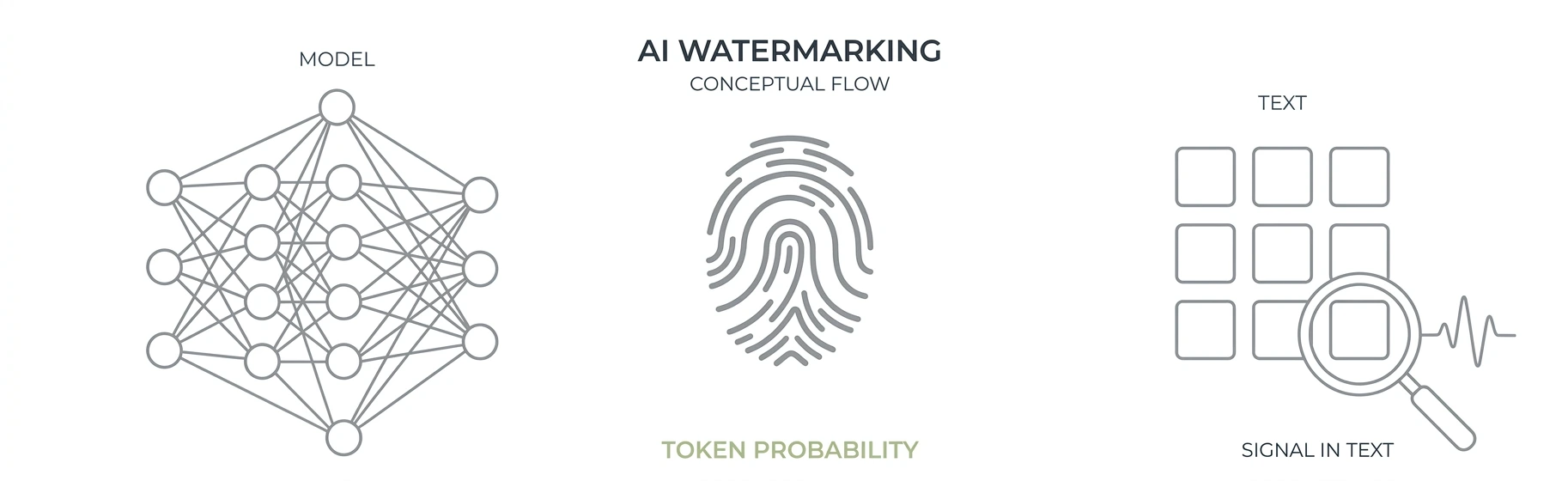
Large language models generate text one token at a time, assigning probabilities to possible next tokens. SynthID adjusts those probability scores during generation in a way that creates a detectable statistical pattern while remaining imperceptible to readers.
DeepMind says SynthID can watermark images, audio, text and video across Google’s generative AI products. It also stresses that the technology is not a complete solution for identifying everything created by AI.
That makes the current Claude discussion particularly interesting.
A major consumer LLM was already watermarking text more than two years ago. Yet Claude’s implementation is generating a much more visible conversation around what AI provenance could mean for writers, publishers and SEO teams. The technology is not entirely new. The context around it is.
OpenAI: Images and Audio Now, Text Is the Goal
OpenAI offers another useful comparison because it clearly distinguishes between different types of provenance signals.
According to OpenAI’s official provenance documentation, supported images generated through ChatGPT, Codex and the OpenAI API include both C2PA Content Credentials and SynthID watermarks. Supported OpenAI-generated audio includes an inaudible SynthID watermark.
OpenAI explains that C2PA metadata can carry information about the origin or history of a file, while SynthID places a signal directly into the generated media. Metadata can sometimes disappear through editing, conversion or platform processing, while embedded signals may survive some transformations.
Ordinary ChatGPT text is not currently listed as a supported provenance type in that documentation.
However, OpenAI explicitly states that its goal is to expand provenance signals to all modalities, including text, as standards and tooling mature.
So OpenAI’s current position is quite clear: image and audio provenance are already deployed in supported workflows, while text is part of the stated direction.
What About Microsoft, Meta and Perplexity?
The broader market is less uniform, which is why it is misleading to simply say “all LLMs watermark their text.”
Microsoft’s current Microsoft 365 watermarking documentation covers AI-generated or AI-altered images, video and audio. Organizations can enable visual watermarks for video and audible disclosures for audio, while users can enable visual watermarks for AI-generated or altered images. Microsoft also says additional provenance-related metadata is currently added to supported images, with work underway for video and audio. Its current page does not describe an equivalent watermark for ordinary Copilot-generated prose.
Meta has similarly documented extensive provenance work for generated media. In its official explanation of AI-generated image labelling, Meta says photorealistic images created using Meta AI can contain visible markers, invisible watermarks and embedded metadata. Meta has also worked on detecting standardized signals such as C2PA and IPTC information in content produced by other companies.
That production documentation is focused on media rather than ordinary Llama-generated text.
This distinction is particularly relevant for Llama because Meta distributes downloadable model weights that developers can customize and deploy independently. The official documentation therefore does not establish a mandatory Meta-controlled text watermark across independently operated Llama deployments.
Perplexity presents another interesting case.
The company’s current Sonar documentation describes Sonar as a search-grounded model for generating answers using real-time web results, but it does not document a dedicated text watermark comparable to Claude’s system or Gemini’s SynthID.
Perplexity does, however, explicitly address provenance in its Acceptable Use Policy. Users are prohibited from removing watermarks, metadata or other indicators intended to identify outputs as artificially generated or manipulated, whether those indicators belong to Perplexity or to third-party models. The policy also prohibits presenting AI-created material as solely human-created or otherwise misrepresenting its provenance.
That is an important distinction: Perplexity acknowledges and protects provenance signals at the policy level, while its current public Sonar documentation does not describe its own Claude-style statistical text watermark.
How the Major Platforms Compare
| Platform | What its official documentation currently says |
| Claude / Anthropic | Supported generated text carries embedded watermarks; supported files can carry signed provenance metadata. New models launched from August 2, 2026 support marking at launch. |
| Gemini / Google | SynthID has been used to watermark Gemini-generated text since May 2024, alongside image, audio and video applications. |
| ChatGPT / OpenAI | Supported images use C2PA and SynthID; supported audio uses SynthID. OpenAI says expanding provenance to text is a goal. |
| Microsoft 365 / Copilot | Current documentation covers watermarks and provenance measures for generated or altered image, video and audio content, not ordinary generated prose. |
| Meta | Official production documentation covers visible markers, invisible watermarking, metadata and AI-content labels for generated media. |
| Perplexity | Its policy protects provenance indicators from removal, but current Sonar documentation does not describe a dedicated text watermark. |
The comparison makes the real story clearer.
Claude’s implementation matters, especially because it applies directly to text.
But provenance itself has been developing across the AI industry for years.
So Why Is Claude’s Watermarking Getting So Much Attention?
This is where the story becomes more interesting than the technical announcement alone.
A watermark on an AI-generated image is easy to understand. People have been familiar with watermarks on visual media for decades.
An invisible signal travelling inside ordinary written language feels different.
It raises immediate questions for writers, publishers, students, marketers and SEO teams because text is often edited, copied, repurposed and mixed with human writing.
But Claude’s own documentation shows why some of the more dramatic interpretations go too far.
A detected mark does not prove Claude originated the material. An undetected mark does not prove a human wrote it. Significant editing can affect detection. And very short passages may not produce a reliable result.
So the emergence of watermarking does not suddenly give us a perfect AI detector.
What it gives us is another provenance signal.
The more interesting question is what publishers, platforms and regulators eventually do with those signals.
What Does This Mean for SEO?
This is also where it is important not to turn an interesting development into an unsupported Google ranking theory.
Google has not said in its published Search documentation that Claude watermarks, Gemini SynthID signals or other AI text watermarks are ranking factors.
Its current guidance on generative AI content says generative AI can be useful for research and for adding structure to original content. The warning comes when generative AI or other automation is used to create many pages without adding value for users.
Google’s spam policies define scaled content abuse around producing many pages primarily to manipulate search rankings rather than help users. Google specifically says the policy applies regardless of how the content was created and includes mass-generating low-value pages with generative AI as one example.
That distinction is central.
Google’s documented concern is not simply that AI touched the copy. The concern is whether automation is being used to produce low-value content primarily for search manipulation.
Google’s broader people-first content guidance continues to emphasize original information or analysis, substantial value, demonstrable expertise, trustworthiness and content created primarily for people.
Google also explicitly says that E-E-A-T – experience, expertise, authoritativeness and trustworthiness is not itself a single ranking factor. Rather, its systems use a mixture of signals associated with those qualities.
So there is currently no verified basis for saying:
“Google detects Claude’s watermark and penalizes the page.”
And there is equally no verified basis for claiming that a page without a watermark would somehow look suspicious to Google.
Those ideas go beyond Google’s published Search guidance.
The More Interesting SEO Impact Is Content Governance
That does not mean watermarking is irrelevant to SEO.
It means the implications are more likely to appear first in the content workflow than in a new direct ranking penalty.
Google already encourages publishers to think about the “Who, How and Why” behind content.
Its guidance says accurate authorship information can help users understand who created something. For AI-generated or AI-assisted content, Google says explaining how automation was used can provide helpful context where readers would reasonably expect that information. And the most important “Why,” according to Google, is that content should primarily exist to help people rather than attract search traffic. That makes provenance useful in a different way.
For a publisher, the important question may increasingly become less about:
“Can anyone prove AI was used?” and more about: “If AI was used, what editorial value did we add?”
Did someone check the sources?
Did someone with relevant expertise review the article?
Did the publisher add original research, experience, data or analysis?
Does the final piece offer something that a reader would not get by simply asking the same model the same question?
Those are editorial questions rather than new Google rules. But they map much more closely to Google’s documented quality guidance than attempts to make AI use “undetectable.”
AI Provenance and AI Quality Are Two Different Things
This may be the most important takeaway from the entire debate.
A watermark can potentially help establish that an AI system participated in creating or processing content.
It cannot establish that the content is bad.
It also cannot establish that the content is good.
Anthropic says a Claude mark does not confirm the complete provenance of the underlying material.
OpenAI similarly says its provenance signals do not prove that content is accurate, unedited, legally owned or presented in the right context.
Google DeepMind describes SynthID as an important building block for AI identification rather than a complete solution.
Across those three companies, the message is surprisingly consistent:
Provenance is a signal, not a verdict.
That distinction matters enormously for publishers and SEO teams.
A machine-readable watermark cannot tell you whether an article contains original research, whether the conclusions are accurate, whether the author genuinely understands the topic or whether the reader will find the page useful.
Those are separate questions.
The Bigger Shift: From AI Detection to AI Accountability
For years, a large part of the AI-content debate has focused on a fairly simple question:
Can you tell whether AI wrote this?
Claude’s new marking system shows why that question may become less useful over time. Someone could write an article themselves and ask Claude to proofread it. A journalist could use an AI tool to summarize an interview transcript. A marketer could draft a piece and ask an LLM to reorganize the structure. A company could use AI to translate content written entirely by its own subject-matter experts. All of those cases involve AI. They do not represent the same level of AI authorship. Anthropic explicitly acknowledges that distinction in its own limitations. A Claude mark may indicate processing by Claude even when the underlying ideas or source text originated elsewhere.
That points toward a more useful way of thinking about AI content: The real question may eventually be less about whether AI touched something and more about who is willing to take responsibility for the finished work.
That is particularly relevant for SEO.
Google’s latest guidance for generative AI features in Search continues to tell publishers to create valuable, non-commodity content and rely on the same foundational SEO principles that apply to traditional Search.
In other words, the long-term advantage probably does not come from finding better ways to hide AI assistance.
It comes from adding something that the model alone cannot easily provide.
Final Thoughts
The attention around Claude’s text watermarking is understandable, but the history matters.
Google DeepMind publicly introduced SynthID text watermarking in Gemini in May 2024. OpenAI currently uses provenance technologies for supported images and audio and says text is part of its intended direction. Microsoft and Meta already use different watermarking, metadata and labelling approaches for AI-generated media. The European Union’s AI-content transparency obligations are now applicable, and around 190 organizations have signed the related Code of Practice.
Claude therefore is not starting the AI-provenance conversation.
It is arriving at the point where that conversation is becoming much harder to ignore.
For SEO teams, there is currently no verified evidence in Google’s published guidance that a Claude watermark or another AI provenance signal automatically harms rankings.
Google’s documented position is still much more straightforward: focus on accuracy, quality, relevance and useful people-first content, and do not use automation to scale pages that add little value for the purpose of manipulating Search.
So perhaps the most useful takeaway from the Claude debate is not:
“AI-written text can now be detected.” It is: “AI provenance is becoming more transparent, so publishers need to be clearer about what humans contribute after AI enters the workflow.”
If machine-readable provenance becomes standard infrastructure, hiding which tool helped create the first draft may become less important.
Making the final work worth publishing will matter much more.
Comments are closed