A practical guide to building a B2B SEO strategy around the right buyers, the right searches, and the business outcomes that actually matter.
By the time a B2B buyer talks to sales, they have probably already Googled you. More than once.
They may have searched the problem first, then possible solutions, pricing, competitors, and proof that your company can actually deliver.
That is where B2B SEO comes in.
The goal is not to win the traffic contest. It is to make sure your brand finds where the right buyers are, and ask the right questions.
Here is how to build a B2B SEO strategy around that journey.
Key Takeaways
- B2B SEO should prioritize qualified demand over raw traffic.
- Search volume matters less when one customer can be highly valuable.
- Different people involved in one purchase may search for completely different information.
- Strong content, technical SEO, and clear positioning need to work together.
- Rankings are useful, but leads and pipelines are what connect SEO to the business.
What Is B2B SEO?
B2B SEO is the process of improving a company’s organic search visibility for the searches that businesses make and the people involved in their buying decisions.
The fundamentals are familiar: keyword research, content, technical SEO, links, and on-page optimization.
How each component is used is the difference.
Instead of B2C who can be anybody you want to reach, B2B buyers often spend more time researching, bring more people into the decision, and need more information before they are ready to talk to sales.
That means your SEO strategy has to support the whole research process, not just the final commercial search.
Step 1: Start With the Buyer
Instead of starting off just with a keyword tool, think about the people you actually want to reach.
Talk to sales. Review CRM notes. Look at customer questions. Pay close attention to past objections and deals that fell through.
You want to understand:
- What is the problem buyers are trying to solve?
- How do they describe these problems?
- What information do they need to know?
- What are their concerns that slow the decision down?
- Who else gets involved before a purchase is made?
For example, a practitioner may search for how to fix a workflow problem, while their manager searches for software options and finance looks for ROI.
Same purchase, different searches.
This is why B2B SEO works best when it is connected to real customer language rather than generic personas.
Google’s own guidance on helpful content reinforces the same principle: create content for a real audience and make it genuinely useful.
Step 2: Map the Buying Journey
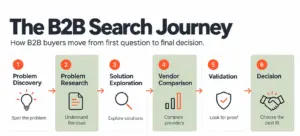
B2B buying journeys are rarely neat.
A prospect may discover your company through an educational article, return weeks later through a comparison page, read a case study, and then search your brand directly.
A useful search journey might look like:
- Problem discovery
- Problem research
- Solution exploration
- Vendor comparison
- Validation
- Decision
For example:
- “Why is our forecasting inaccurate?”
- “How to improve forecasting”
- “Sales forecasting software”
- “Best forecasting platforms”
- “Company A vs Company B”
- “Company A pricing”
Each stage needs different content.
Your job is not to try to predict each click made, but to make sure to cover all grounds for major questions.
Step 3: Research Keywords Around Intent
Now the keyword tools have become useful.
Start with business problems and use cases, then expand into:
- category searches
- pricing
- costs
- comparisons
- alternatives
- software or services for a specific need
- educational questions
Try not to judge every keyword by search volume alone.
A broad keyword with 10,000 searches could be less valuable than a highly relevant term with only 200 searches if those 200 people are much closer to becoming customers.
Look at:
- relevance
- search intent
- commercial value
- competition
- what currently ranks
- whether you can create something better
- what the visitor should do next
Google’s Search Essentials also recommends using the language people actually search for in important parts of a page.
While it may sound obvious, it is surprisingly easy to lose when you become tunnel-visioned by your internal company language.
Step 4: Match Keywords to the Right Pages

When you find a keyword, it does not automatically mean writing a blog post about it.
Different searches require different destinations.
A strong B2B site might include:
- service pages
- industry pages
- solution pages
- comparison pages
- case studies
- guides
- FAQs
- tools or templates
Group related keywords by intent and assign them to the page that makes the most sense.
This helps avoid keyword cannibalization, where multiple of your pages are now competing against each other for similar keywords, and creates a more logical website structure.
Internal or back links that are embedded within your texts, should support that structure too.
A guide should lead naturally to related services, case studies, or deeper information instead of leaving the visitor at a dead end.
Step 5: Create Content That Adds Something
Publishing consistently really doesn’t mean you are publishing well.
The best B2B content gives the reader something interesting they could pick up that couldn’t be found in the ten interchangeable search results.
That might be:
- original research
- detailed implementation advice
- customer examples
- comparisons
- case studies
- frameworks
- expert commentary
- pricing or cost explanations
While it can be discouraging seeing multiple search results for the topic you want, your biggest advantage is often inside the business already.
Sales knows the objections. Product knows where customers get confused. Customer success knows what happens after purchase.
Know how to use these people.
Google’s guidance continues to emphasize original, useful, people-first content rather than pages created mainly to attract search traffic. Its current AI guidance also makes one thing clear, it is not an issue whether AI was used, but whether the output adds value and avoids scaled low-quality content.
AI can definitely speed up production, but it cannot replace expertise.
Step 6: Optimize for Search and Conversion
Once the page exists, make sure it is easy to understand.
Focus on:
- a clear title
- one descriptive H1
- useful subheadings
- a strong introduction
- descriptive URLs
- relevant internal links
- accurate metadata
- a logical call to action
Then ask another question:
What should this visitor do next?
Someone early in the buying journey may want more information through another guide or a case study.
Someone comparing providers may want pricing, proof, or a conversation.
Not every page needs to shout “Book a Demo.” or a loud CTA that annoys a genuine reader.
SEO gets the right person onto the page. Good UX and messaging help them continue.
Step 7: Keep the Technical Foundation Healthy
Strong content still needs to be crawlable, indexable, and usable.
Regularly review:
- indexation
- XML sitemaps
- robots directives
- redirects
- canonical tags
- broken links
- site structure
- mobile usability
- page speed
Think of technical SEO as infrastructure. You may not notice it when everything is running fine, but one overlooked link or small problem can stop strong pages visibility and performance begins to drop.
Step 8: Build Authority

Off-page SEO is bigger than collecting backlinks.
Strong links usually come from doing something worth referencing.
That can include:
- original research
- digital PR
- expert contributions
- partnerships
- industry publications
- podcasts
- useful resources
A relevant editorial link from a trusted industry site is far more valuable than a batch of random links purchased for volume.
Google’s spam policies are also clear about manipulative link practices.
These businesses rely on trust and reliability, so build authority like you would build reputation.
Slowly, credibly, and have purpose with each step.
Step 9: Think Beyond Traditional Search
Search in 2026 is no longer limited to a page of blue links.
Buyers are also using AI Overviews, AI Mode, and standalone AI tools to research companies and categories.
The good news is that many of the same fundamentals still apply.
Google says its AI search features do not require a separate technical optimization process beyond standard SEO foundations.
Clear answers, strong structure, original expertise, credible sourcing, and consistent brand information all help.
Loop’s guide to AEO and GEO goes deeper into that side of visibility.
Step 10: Measure What Matters
Rankings and traffic are useful indicators.
They are not the end goal.
Track search performance first:
- impressions
- clicks
- rankings
- relevant queries
- landing pages
Then connect that activity to business outcomes where possible:
- contact requests
- demos
- qualified leads
- sales opportunities
- influenced pipeline
- revenue
Google Search Console is a good starting point for understanding how people are finding you through Google Search.
B2B attribution will never be perfectly clean.
Someone may discover you organically, return through social media, share a page internally, then convert through a branded search.
SEO may influence the deal without receiving the final click.
That is also why zero-click search is becoming more important to understand.
Step 11: Partner With A SEO Agency
A B2B SEO strategy works when you have the right tools to execute it.
For many teams, they already understand the value of SEO, but they do not have the time, expertise, and structure to scale it consistently.
Getting in contact with the right agency can help propel your SEO strategy to the next level, helping you prioritize opportunities, improve technical SEO, strengthen content, and connect visibility to real business growth.
If your team wants to support building a smarter SEO system, consider Loop for help. We work with you to bring structure and any means for growth, striving for results that continue on after we’re done.
A Simple 90-Day Plan
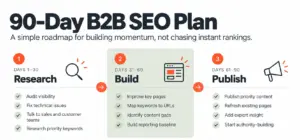
Days 1–30
- audit current visibility
- fix major technical issues
- speak with sales and customer teams
- map buyers and search intent
- research priority keywords
Days 31–60
- improve important commercial pages
- map keywords to URLs
- identify content gaps
- strengthen internal links
- build a reporting baseline
Days 61–90
- publish priority content
- refresh existing pages
- add expert insight
- start authority-building activity
- review early performance
Ninety days is enough to build a strong foundation, but it doesn’t promise instant rankings.
SEO works better as a system than a campaign.
Common B2B SEO Mistakes
A few patterns come up again and again:
Chasing traffic: Trying to garner huge amounts of traffic means nothing if they are the wrong visitors.
Only targeting big keywords: Smaller, high-intent searches can be much more valuable.
Publishing generic content: If anyone could have written it, it is unlikely to build much authority.
Ignoring sales insights: Your sales team hears customer language every day. Use it.
Stopping at rankings: Ranking is a means to an outcome, not the outcome itself.
How Loop Agency Thinks About B2B SEO
Before deciding what content should even be created or optimized, Loop focuses on positioning, audience, search intent, and messaging first. Strong SEO should make a brand easier to discover, understand, and trust, whether that discovery happens through traditional search or newer AI-driven experiences. Our latest look at AI search explores that shift in more detail.
Frequently Asked Questions
What is B2B SEO?
B2B SEO is the process of improving organic visibility for searches made by businesses and the people involved in their buying decisions. It combines keyword research, content, technical optimization, authority building, and conversion strategy.
How is B2B SEO different from B2C SEO?
B2B SEO often involves longer research cycles, more stakeholders, smaller search volumes, and higher-value conversions. Content usually needs to educate and validate a decision rather than push an immediate purchase.
How do you create a B2B SEO strategy?
Start with your buyers, map their research journey, identify relevant searches, match keywords to the right pages, create useful content, strengthen technical SEO, build authority, and measure business outcomes.
Is SEO worth it for B2B companies?
Yes, especially when prospects actively research problems, solutions, vendors, pricing, or implementation online. The strongest programs focus on commercially relevant visibility rather than traffic alone.
Final Takeaway
Strong B2B SEO is not about publishing the most content or chasing the biggest keywords.
It is about becoming useful at the right moment.
Understand what buyers need, show up when they are looking for it, and make sure the experience after the click gives them a reason to trust you.
That is what turns search visibility into something more valuable than traffic.
Comments are closed