Artificial intelligence now sits inside almost every brand-marketing workflow from the headline a strategist tweaks to the voice that reads it, the spokesperson in a paid social ad, the testimonial on a landing page. That speed has created a new problem for brands: audiences can no longer always tell what is real. In 2026, brands do not face one single U.S. AI disclosure law. Instead, they face a patchwork of FTC deceptive-advertising rules, fake-review rules, state synthetic-media laws, right-of-publicity risks, EU transparency obligations, and platform policies. Together, these rules put fresh responsibility on the brand paying for the content. If your team runs paid social, works with creators, or uses generative tools anywhere in production, you need to know what must be labelled and how.
This guide breaks down what counts as AI content under the new rules, what regulators and platforms expect you to disclose, what happens if you skip it, and how to build a labelling habit that protects your brand without slowing your team down.
Table of Contents
- What Are AI Disclosure Rules for Brands?
- Why AI Disclosure Matters in 2026
- What Types of AI Content Need a Label?
- How to Disclose AI-Generated Content Clearly
- What Happens If Brands Fail to Disclose AI?
- Who Is Responsible for AI Disclosure?
- How to Build an AI Disclosure Process
- Why AI Transparency Can Build Brand Trust
- How Loop Agency Approaches AI in Brand Work
- FAQs
Key Takeaways
- As a practical risk test, disclosure is most important when AI could change what the audience believes they are seeing, hearing, or who is speaking.
- The brand running the campaign carries the most legal exposure. Agencies and creators carry their own. Contracts shift risk between parties but do not get the brand off the hook.
- The most common gap is undisclosed AI testimonials and synthetic spokespeople in paid social; the worst cases are not just under-labeled, they are flat-out prohibited.
- Platform AI labels (Meta, TikTok, YouTube) are a starting point. The standard for a real disclosure is higher.
- Clear disclosure is a brand-trust lever as much as a legal one. In a market drowning in synthetic content, transparency reads as confidence.
Why AI Disclosure Laws Matter for Brands Now

For decades, disclosure in advertising came down to one question: was this paid for? The FTC built its rules around that idea, and brands got used to adding tags like “ad,” “sponsored,” or “paid partnership.” Most marketing teams have that part down. You can see how those expectations have evolved in our look at how marketing agencies are adapting to AI.
AI brings a second question that is just as important: was this real? When an ad uses a synthetic voice, when a spokesperson was generated rather than hired, or when a testimonial was written by a model instead of spoken by a customer, audiences have a right to know. Regulators take the same view. The FTC has been clear that AI-generated endorsements can be deceptive even when nothing in the ad copy is technically false, because the format itself sends the wrong signal.
The stakes are practical, not only legal. Brand trust is hard to build and easy to lose. If a customer finds out later that the “person” who recommended your product was an AI model running off a script, that trust does not recover quickly. AI disclosure laws give brands a way to use these tools without putting the audience relationship at risk.
What Counts as AI Content You Must Label
Not every use of AI needs a label. A copywriter using a tool to draft headline options did not deceive anyone. The line falls where AI changes what the audience believes they are seeing or hearing. Here is a simple way to sort it.
The more believable a piece of AI content a face, a voice, a before-and-after, a product shot the closer it sits to a disclosure obligation. Stylized output (illustrated, surreal, obviously generative) sits lower on the risk curve. When you are unsure, label it. The brand-strategy test cuts through most ambiguity: if a reasonable customer would feel misled to learn AI was involved, that is your answer.
How to Disclose AI Content the Right Way
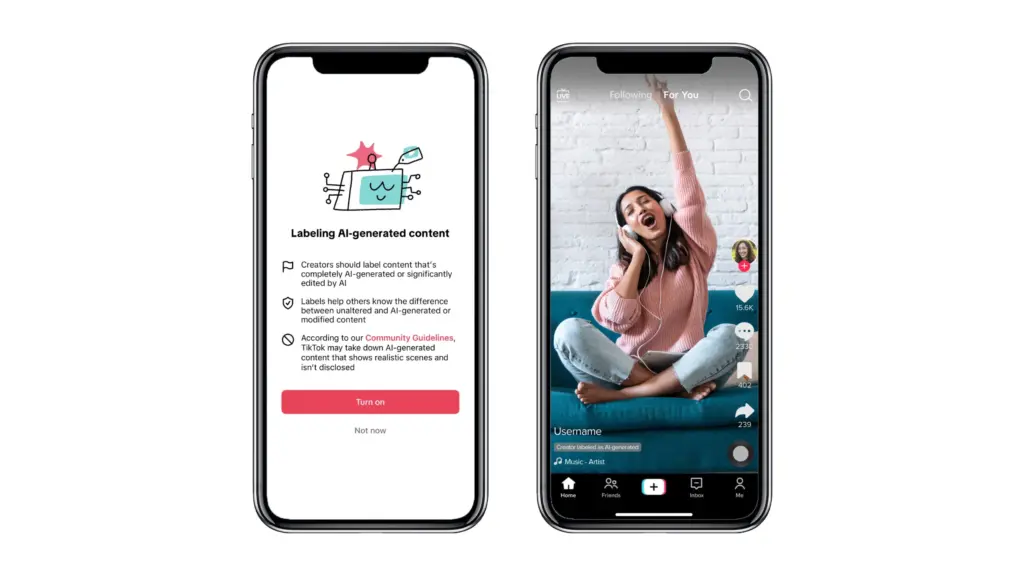
Source: Tiktok
A good disclosure is easy to see and easy to understand. The legal phrase is clear and conspicuous, which is fancy language for: not buried, not vague, and in the same medium as the claim. Translate that by format:
- Video. On-screen label in the first three to five seconds, legible long enough to read. Add an audio disclosure when the AI element is the voice.
- Static image. Label in-frame or in the visible caption not in alt text, not in a footer.
- Written content. Disclose near the top, close to the claim. A site-wide AI disclaimer in a privacy policy does not count.
- AI personas. Disclose persistently. The bio, every post, every video frame, not just the first introduction.
- Sponsored AI. Two disclosures stack: a partnership label and an AI label. Do not merge them.
Use plain language: “Created with AI,” “AI-generated voice,” “Virtual creator.” Avoid soft words like “enhanced” or “digitally produced” ; they leave the audience guessing. Platform-native tags (Meta’s “AI info,” YouTube’s altered-or-synthetic toggle, TikTok’s AIGC label) are a useful floor, but treat them as a starting point. Keep a simple log of what was AI, who approved it, and how it was disclosed.
The Cost of Getting AI Disclosure Wrong

Skipping disclosure is not a small risk you can quietly absorb. In the U.S., deceptive-endorsement and fake-review violations carry meaningful civil penalties, and the brand pays not just the creator. In Europe, the new AI Act penalties land in the millions-of-euros range. Regulators can also order corrective advertising, which forces you to admit the issue in public. That correction often does more brand damage than the original fine.
Then there is the platform layer. Meta, TikTok, YouTube, and Google Ads can take assets down, throttle reach, demonetize content, and in serious cases restrict ad accounts. Detection systems flag synthetic content even when nobody self-discloses, and a retroactive flag costs more reach than a proactive label ever does.
The reputational cost is the one that lingers. A single screenshot of an undisclosed AI testimonial can ricochet across social platforms in hours and erase months of careful brand building. Disclosure is cheap insurance against all three.
Who Is Responsible: The Brand, the Agency, or the Creator?
All three, with the brand bearing the most. Regulators have been explicit that the company paying for an endorsement is on the hook for it, AI or not. Agencies producing the deceptive creative carry their own exposure. Creators carry theirs. Contracts can shift risk between parties; they cannot make a regulator look the other way.
The practical move is to push disclosure obligations into every contract. Marketing agencies adapting to AI are already adding AI clauses to creator agreements, SOWs, and vendor terms including a requirement to disclose AI use and indemnification when someone does not. Tell partners exactly when and how to label AI elements. Build a quick pre-publish check that confirms it. A creator who knows your standard will fold disclosure into their workflow, and you both avoid a scramble later.
Building an AI Disclosure System That Scales
Rules only help when your team follows them every time. The goal is to make disclosure automatic, so no one has to remember it under deadline pressure. A few moves to put in place this quarter:
- Write a one-page internal AI policy. What is permitted, what gets labeled, your preferred wording, and where labels go on each format. Short enough that people will actually read it.
- Add a pre-publish disclosure checkpoint. Before anything ships, someone confirms whether AI was used and whether it needs a label.
- Update creator and agency contracts. Require AI disclosure, require platform-label compliance, add indemnification for failures.
- Keep a content-asset log. Record what was AI, the tool, the approver, and the disclosure method.
- Review quarterly. Rules and platform tools are still moving. A short check every few months keeps your policy current.
Frame it as a brand-trust system, not a compliance burden. The teams that publish faster because the disclosure question is already answered upstream win both legally and creatively.
AI Disclosure as a Brand-Trust Advantage
Most brands will treat disclosure as something to do quietly, with the smallest possible label. That is a missed positioning move.
In a market where customers can no longer easily tell what is real, the brand that volunteers the answer earns credibility. Staying visible in AI answers increasingly depends on being identifiable, attributable, and trustworthy across surfaces. Hidden AI undermines all three. Done well, disclosure becomes part of the creative an honest beat, not a disclaimer.
How Loop Agency Thinks About AI in Brand Work
We use AI across client work where it serves the brand concept, production efficiency, scaled content, synthetic creative and labels where it should be labeled. Disclosure is part of the creative process, not a legal afterthought bolted on at the end.
FAQ
When do brands legally need to disclose AI-generated content?
Whenever AI changes what the audience reasonably believes they are seeing, hearing, or who is speaking. That covers synthetic spokespeople, AI voiceovers, deepfakes, AI testimonials, and photorealistic synthetic imagery presented as real. Tools that just help a real person work faster usually don’t need a label.
Do I need to disclose AI if it was only used to edit a real video?
Generally no, as long as the editing is assistive color, denoising, basic cuts, caption polishing. The line is whether the edit changes what the audience believes. AI used to alter who is speaking, what they said, or what the product looks like crosses into labeling territory.
Who is liable if an AI ad is not disclosed to the brand or the agency?
Both, with the brand bearing the most. The company paying for the endorsement carries primary liability. Agencies have separate exposure for producing deceptive creative. Creators carry their own. Contracts can shift risk between parties but do not change how regulators see it.
Are virtual influencers required to disclose that they’re AI?
Yes. A fully synthetic creator needs to make the AI nature plain in the campaign, not buried in a profile bio few people read. If the partnership is paid, you also need a separate sponsorship disclosure. Two labels, not one.
How should brands label AI content on social media in 2026?
Turn on the platform-native label (Meta’s “AI info,” YouTube’s altered-or-synthetic toggle, TikTok’s AIGC label), and add a clear in-frame or in-caption disclosure on top. Place the label in the same medium as the AI element on-screen for video, visible caption for images, near the claim for written content.
Work With Loop Agency
If you are sizing up your brand’s exposure to AI disclosure rules or designing the creative system that handles them cleanly from the start we can help. Talk to the Loop Agency team about brand strategy and creative work that uses AI responsibly and keeps the audience first.