Last Updated June 2026 · 11 min read
Paid search marketing helps businesses show up when people are actively looking for something. Here is how it works, what you pay for, and what makes it effective.
You search “best accounting software for small business” because your current setup is starting to become a problem. Or maybe it is “emergency plumber near me,” which is usually a much less calm situation.
Whatever the case may be, you know what you need in this situation.
That is where paid search marketing comes in. It lets businesses place ads in search results to meet people when they are actively looking for a relevant product, service, or solution.
The value in this isn’t just visibility. It’s showing up at the right moment, with a useful message, and giving that person somewhere relevant to go next.
Here is how paid search works and what actually makes a campaign worth the spend.
Key Takeaways
- Paid search helps brands reach people who are already searching for something relevant.
- Advertisers commonly pay based on an action like clicks.
- The highest bidder does not automatically get the best position.
- Strong landing pages and conversion tracking matter just as much as the ad itself.
- Paid search works best when it is measured against real business outcomes,
What Is Paid Search Marketing?
Paid search marketing is advertising on search engines where businesses will pay to feature for relevant searches when someone looks up a specific topic.
The most popular platform associated with paid search is Google Ads, although Microsoft Advertising also serves search ads.
You will also hear the term PPC, or pay-per-click. Sometimes it will overlap with paid search but they are not exactly the same.
PPC is a payment model where an advertiser pays when someone clicks. Paid search refers specifically to advertising in search environments.
For example, someone searches “commercial cleaning company Toronto.” A cleaning company may bid to show an ad for that search and pay when the person clicks.
The appeal is simple: the customer is already looking, you just need to be there.
How Does Paid Search Work?
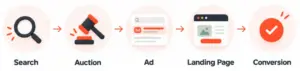
When someone searches, Google runs an automated auction to decide which eligible ads may appear and where.
The process looks roughly like this:
- Someone enters a search.
- Google checks which advertisers may be relevant.
- Eligible ads enter an auction.
- Google evaluates factors such as bids, relevance, quality, and search context.
- Ads may appear in the results.
The biggest misconception here is that whichever advertiser spends the most is the winner.
Google’s current explanation of Ad Rank shows that bids are only part of the decision. Ad quality, landing-page experience, competition, and the context of the search also play a role.
That means having relevance is important.
What Are You Actually Paying For?
One of the most common paid search pricing models is cost per click, or CPC.
Whenever someone clicks your ad, you get paid.
But cheaper clicks are not automatically better.
A $2 click that goes nowhere is less useful than a $12 click that turns into a strong lead or sale.
That is why instead of focusing on lowering CPC, you should be thinking of bringing in relevant traffic at a meaningful cost that will convert into real value.
Depending on the company, that could mean tracking:
- purchases
- leads
- calls
- bookings
- form submissions
- revenue
What Makes Paid Search Work?
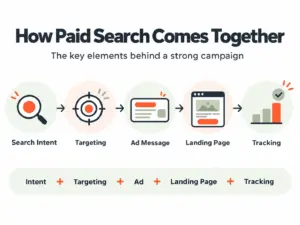
Good paid search usually comes down to a few things working together.
Search Intent
The words someone searches can tell you a lot about what they want.
Compare:
“how does payroll software work”
with:
“payroll software pricing”
The first person is still learning. The second may already be comparing options.
That comparison should be making you think on how to optimize for your ad, the landing page, and how much value you place on that search.
Keywords and Targeting
Keywords are great to help advertising platforms understand which searches may be most relevant for your campaign.
Google currently uses broad, phrase, and exact match types. Its keyword matching now takes into consideration what the user means and surrounding context rather than relying only on literal wording.
That gives campaigns more reach, but it also makes search term reviews more important. Advertisers need to check the actual queries that trigger their ads and leave out any non-relevant searches.
Ad Copy
The ad should be able to carry out immediately why your business is relevant to the search.
Someone looking for pricing probably is looking for different information than someone still learning about the category.
The closer the message fits the search, the more natural the next step feels.
Landing Pages
The click is only a part of the job.
If someone searches for a specific service, clicks a matching ad, and is led to a generic homepage, chances are they exit out without a thought and go back to searching again.
The landing page should be able to continue the same conversation and execute what they need, especially when there is a lot of time sensitivity.
That means the message, offer, proof, and next step should all line up with the search that brought the visitor there.
Loop’s guide to landing pages goes deeper into that part of the experience.
Conversion Tracking
Conversion tracking gives you information of what people actually do after clicking an ad.
Tools like Google’s conversion tracking can measure actions that come after a click like purchases, leads, calls, sign-ups, and downloads.
Without reliable tracking, you don’t necessarily know what worked or what came out of that click.
Paid Search vs SEO
Paid search and SEO both help brands appear in search results, but they work differently.
Area | Paid Search | SEO |
Placement | Paid | Organic |
Speed | Faster visibility | Builds over time |
Cost | Ongoing ad spend | Ongoing content and optimization |
Control | More direct | Less direct |
Longevity | Drops when spend stops | Can continue over time |
Best use | Capture demand now | Build long-term visibility |
Paid search can help you reach demand quickly by popping up where it needs to be. SEO visibility can build a stronger organic presence over time and generate continuous visibility.
The value comes when you use the two together. Paid search can reveal which messages and searches convert, while SEO can help cover the wider research journey.
Benefits of Paid Search Marketing
Paid search allows businesses to have a high level of control over who they target, where they advertise, how much they spend, and what they measure.
The data that you can produce also comes quickly, which makes it useful for when you need to test messages, offers, and search demand.
The biggest advantage here is intent. You don’t need to create interest, but you are reaching people who are already looking for something related to what you sell, making the traffic more purposeful.
How Paid Search Is Changing in 2026
Paid search platforms are increasingly automating bidding, targeting, and creative combinations.
Google’s Performance Max campaigns, for example, can serve across Search, YouTube, Display, Discover, Gmail, Maps, and other Google inventory.
Search ads have also featured in newer AI-driven search experiences. Google currently allows eligible ads to appear around and, in some markets, within AI Overviews through existing campaign types.
Loop’s guide to AI Overview ads looks more closely at how those placements work.
The practical shift is that advertisers are granting more freedom and control to platforms. That makes strong tracking, good landing pages, clear goals, and useful creative even more important with the evolving search quality of consumers.
What Should You Measure?
Clicks are useful, but they should not be the final score.
Depending on the campaign, you may want to track:
- impressions
- clicks
- click-through rate
- cost per click
- conversions
- cost per conversion
- qualified leads
- revenue
The right KPI depends on the business.
An ecommerce company may care about revenue. A B2B company may care more about pipeline. A local service business may focus on booked calls.
This is why good PPC management goes beyond simply getting more clicks.
When Does Paid Search Make Sense?

Paid search brings the most value when people are already looking for the product, service, category, or problem you solve.
We also mention the importance of landing pages, knowing what a conversion is worth, and being able to measure what happens after the click.
In cases of very little existing search demand, it can be less effective. In that case, awareness and education may need to happen before people know what to search for.
Common Paid Search Mistakes
A few mistakes may become a pattern in showing up.
Chasing clicks: More traffic generally has no value if the wrong people are clicking.
Ignoring search terms: Match types are more flexible now, so reviewing what people actually searched matters.
Weak landing pages: Even after getting the click, a confusing landing page can deter users easily.
Poor tracking: If the campaign is measuring the wrong action, optimization will follow the wrong signal.
Trusting automation too much: Automated bidding will require more input and understanding strategy, context, and needing consistent review.
Partner With a Paid Search Agency
Setting up a campaign is fairly straightforward. Managing one well is where the work starts.
Budgets need to be adjusted. Search terms need reviewing. Tracking needs checking. Ads need testing. Landing pages need improving.
Agencies can be helpful if your team needs more expertise, time, or accountability around those decisions.
Loop approaches paid search as part of a wider performance system, connecting intent, creative, landing pages, tracking, and business goals rather than focusing on clicks as the final result.
Frequently Asked Questions
What is paid search marketing?
Paid search marketing is advertising on search engines where businesses pay to appear for relevant searches. It commonly uses a pay-per-click model, meaning the advertiser pays when someone clicks the ad.
Is paid search the same as PPC?
Not exactly. PPC is a payment model where advertisers pay for clicks. Paid search is a specific type of advertising that appears in search results. Many paid search campaigns use PPC pricing.
What is the difference between paid search and SEO?
Paid search buys visibility in search results and can begin driving traffic quickly. SEO focuses on earning organic visibility through content, technical optimization, and authority over time.
How much does paid search cost?
There is no standard cost. It depends on competition, targeting, industry, location, bidding strategy, and the value of the search. The more useful question is whether the cost of acquiring a lead or sale makes sense for the business.
Is Google Ads paid search?
Google Ads includes paid search, but it also covers other advertising formats across YouTube, Shopping, Display, Maps, Gmail, and other Google properties.
Comments are closed